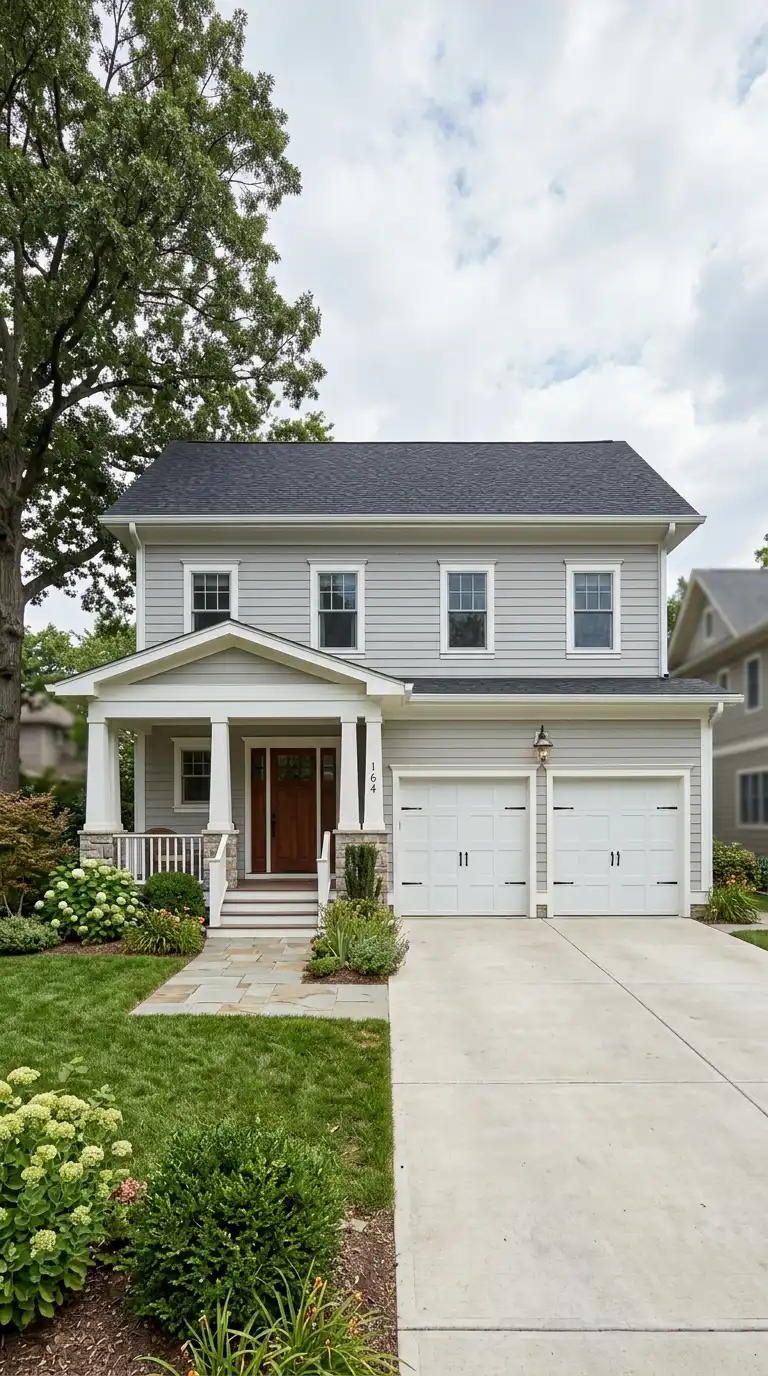
12 Garage Exercise Room Ideas
The garage is one of the most underutilized spaces in the home. It is typically cold, dark, cluttered, and reserved for cars and storage. Yet the garage offers something rare in modern homes: a large, separate, ground-level space with high ceilings and direct outdoor access. These qualities make the garage an ideal candidate for conversion into a home gym. Unlike a spare bedroom that requires moving furniture and worrying about floor joists, a garage can handle heavy weights, loud music, and sweaty workouts without disturbing the rest of the household. From insulating the garage door to installing rubber flooring, from adding wall-mounted racks to creating a yoga nook, here are twelve garage exercise room ideas that will transform your garage into a motivating, functional fitness space.
1. Insulate the Garage Door and Walls for Temperature Control
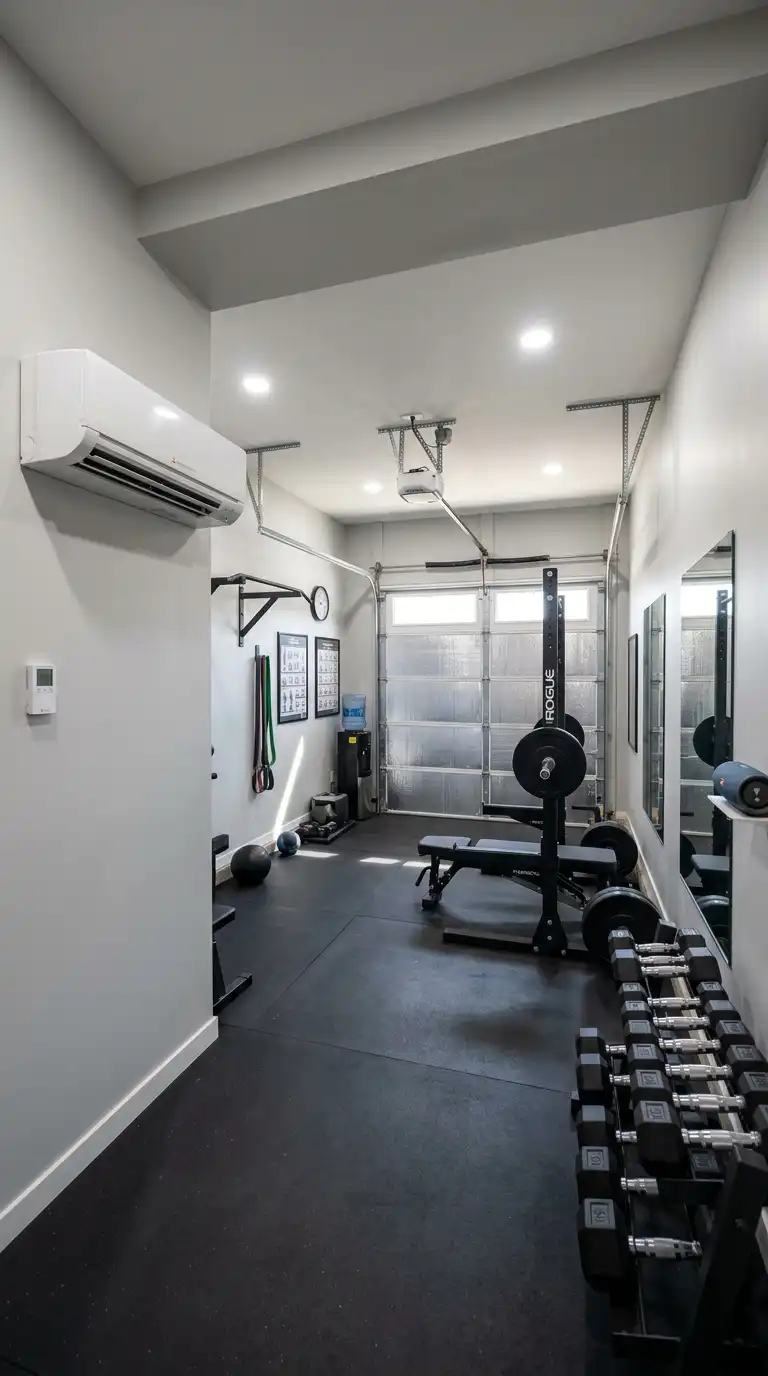
The biggest obstacle to year-round garage workouts is temperature. Uninsulated garages are freezing in winter and baking in summer. A comfortable exercise space requires climate control, and climate control requires insulation. Start with the garage door, which is often the least insulated surface. Foam board insulation kits are available for most standard garage door sizes. These kits consist of rigid polystyrene panels that cut to fit into each door panel recess. The foam reflects heat back into the room and prevents cold from penetrating. For better results, replace the entire door with an insulated model. Insulated steel doors have R-values between 6 and 20, dramatically improving thermal performance.
Next, insulate the walls. If the garage walls are unfinished studs, install fiberglass batt insulation between the studs. Use faced insulation with the vapor barrier facing the interior. Cover the insulation with drywall or plywood. For finished walls, blown-in insulation can be added through small holes. The garage ceiling or attic space above the garage should also be insulated. A mini-split heat pump is the ideal HVAC solution for a converted garage gym. It provides heating and cooling without ductwork and operates quietly. A space heater and window air conditioner can work as a budget alternative. With proper insulation and HVAC, your garage gym will be usable 365 days a year. The investment in comfort directly translates to consistency in training.
2. Install Rubber Flooring or Gym Mats
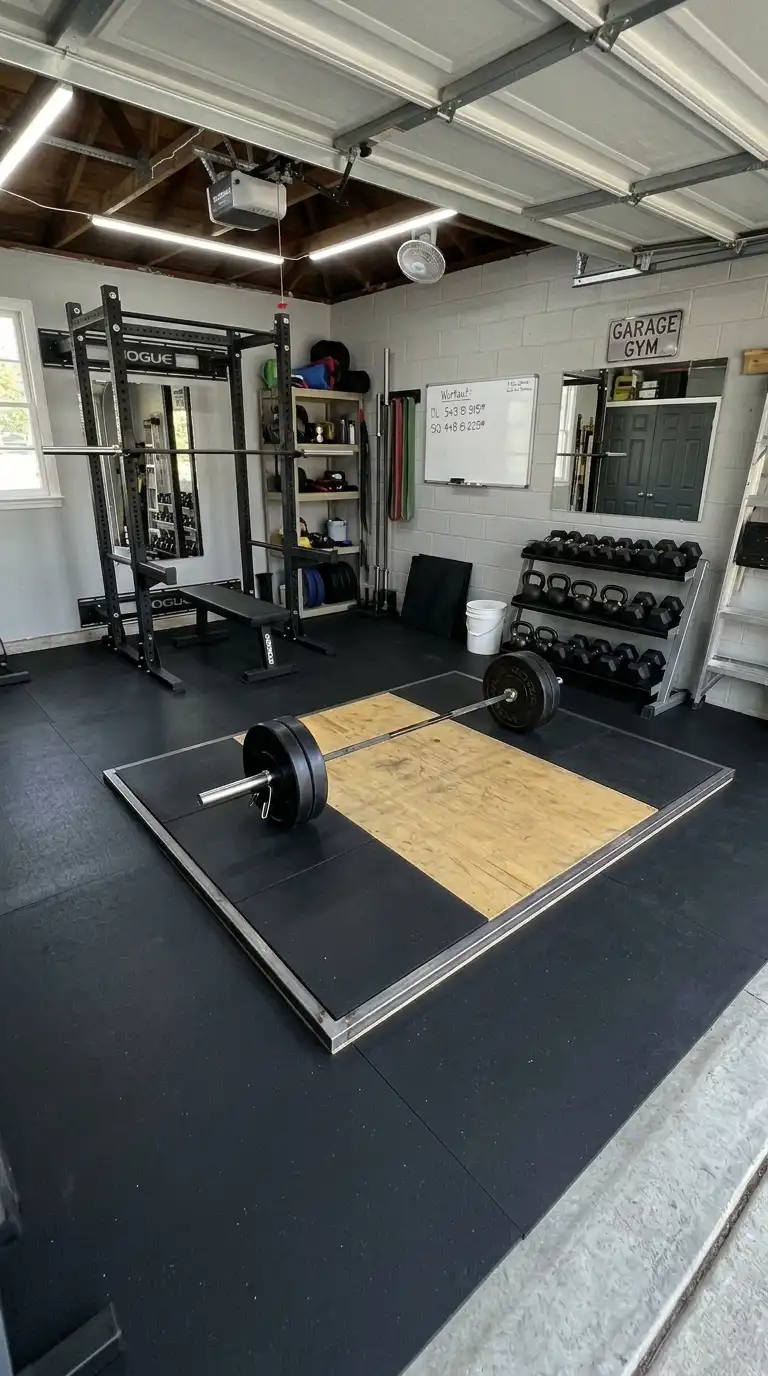
Concrete garage floors are unforgiving. Dropped weights crack them, and standing on them for long workouts causes joint fatigue. Proper flooring is non-negotiable for a garage gym. Rubber flooring provides cushioning, protects the concrete, reduces noise, and creates a dedicated workout zone. The gold standard is rolled rubber flooring, typically 3/8-inch or 1/2-inch thick. It comes in wide rolls and covers the entire floor seamlessly. Black is standard, but colored fleck options are available.
For a more budget-friendly approach, use interlocking rubber floor tiles. These 2×2 foot squares snap together like puzzle pieces. They are easy to install, easy to replace if damaged, and can be taken with you if you move. For heavy deadlifting and Olympic lifting, build a dedicated lifting platform. A standard platform consists of a base layer of plywood, a middle layer of plywood with rubber stall mats on each side, and a center strip of hardwood for sliding. This protects the floor and the weights. Horse stall mats from farm supply stores are an inexpensive alternative to commercial gym flooring. They are 3/4-inch thick, extremely durable, and cost about $40 per 4×6 foot mat. The rubber smell dissipates after a few weeks of ventilation. Whatever flooring you choose, ensure it extends at least six inches up the walls as a cove base to allow for easy cleaning and to prevent moisture wicking.
3. Add Bright, Layered Lighting
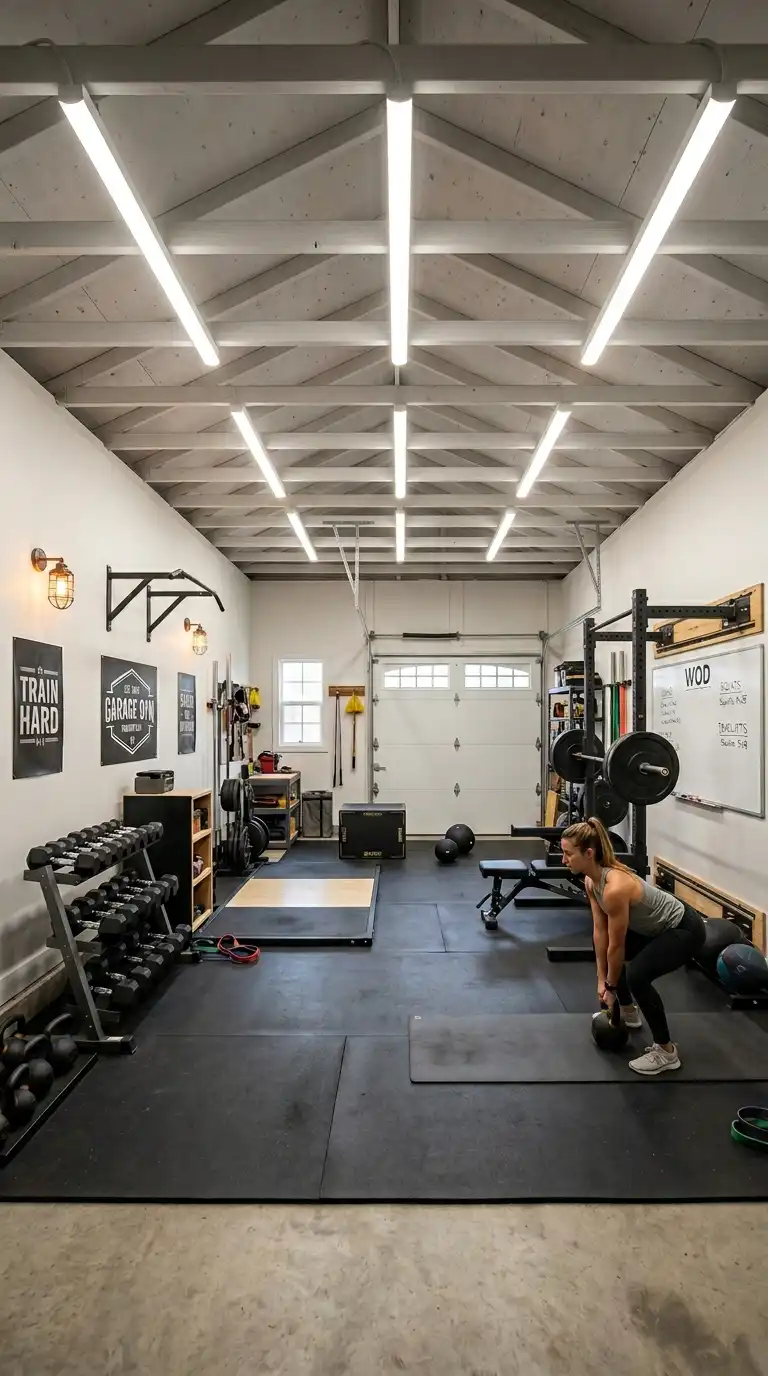
Most garages have a single bare bulb or a pair of fluorescent tube fixtures. This inadequate lighting creates shadows, strains the eyes, and kills motivation. A garage gym requires bright, even, flicker-free illumination. The goal is to eliminate dark corners where you might trip and to see your form clearly in mirrors or videos. Start with overhead LED panel lights or linear LED high-bay fixtures. These produce abundant light and are energy-efficient. For a standard two-car garage, four to six 4-foot LED fixtures provide excellent coverage. Choose fixtures with a color temperature of 4000K to 5000K. This cool white light mimics daylight and keeps you alert. Warmer 3000K light is too sleepy for intense workouts.
Layering adds functionality and ambiance. Add task lighting over specific areas: a bright light over the weight bench, a focused light on the squat rack, or a dimmable sconce near the yoga mat. Under-shelf lighting on wall-mounted storage units illuminates the floor path. For early morning or late evening workouts, install dimmer switches so you can start with lower light and gradually brighten as you wake up. Natural light is also valuable. If your garage has windows, keep them uncovered during workouts. If it does not, consider adding a glass panel to the garage door or installing a skylight. Avoid fluorescent lights, which can flicker and cause eye strain during long sessions. The right lighting makes the space feel professional and energizing rather than gloomy and depressing.
4. Mount a Large Wall Mirror
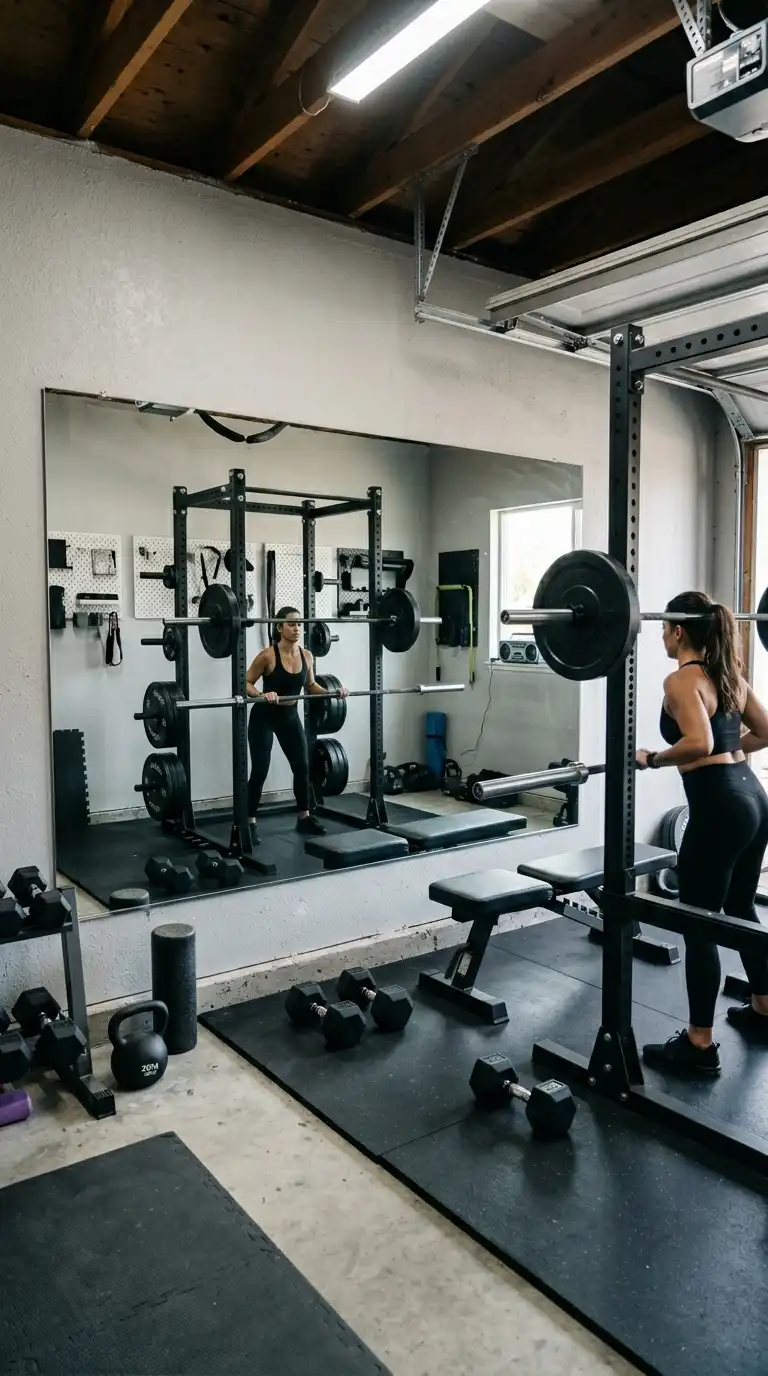
Proper form is essential for effective and safe exercise. A large wall mirror allows you to check your squat depth, deadlift back position, and overhead press alignment without a spotter or a video recording. The mirror also makes the garage feel larger, brighter, and more like a commercial gym. The ideal mirror for a garage gym is a frameless wall-mounted mirror at least 4 feet tall and 6 feet wide. Multiple smaller mirrors butted together can achieve the same effect.
Install the mirror on the longest blank wall in the garage, positioned so you can see yourself from the main lifting area. The bottom edge should be no more than 12 inches from the floor so you can see your feet. Secure the mirror with heavy-duty mirror clips or a Z-bar mounting system. Do not rely on adhesive alone, as garage temperatures fluctuate and vibrations from dropped weights can loosen it. For safety, use mirrored acrylic instead of glass. Acrylic is shatter-resistant, lightweight, and less expensive. It scratches more easily than glass but is much safer in a garage where a weight could fly into it. If you use glass mirrors, attach a safety film to the back so broken glass stays in place rather than showering across the floor. Position the mirror away from the garage door tracks and any windows to avoid glare.
5. Build a Wall-Mounted Pull-Up Bar and Rig
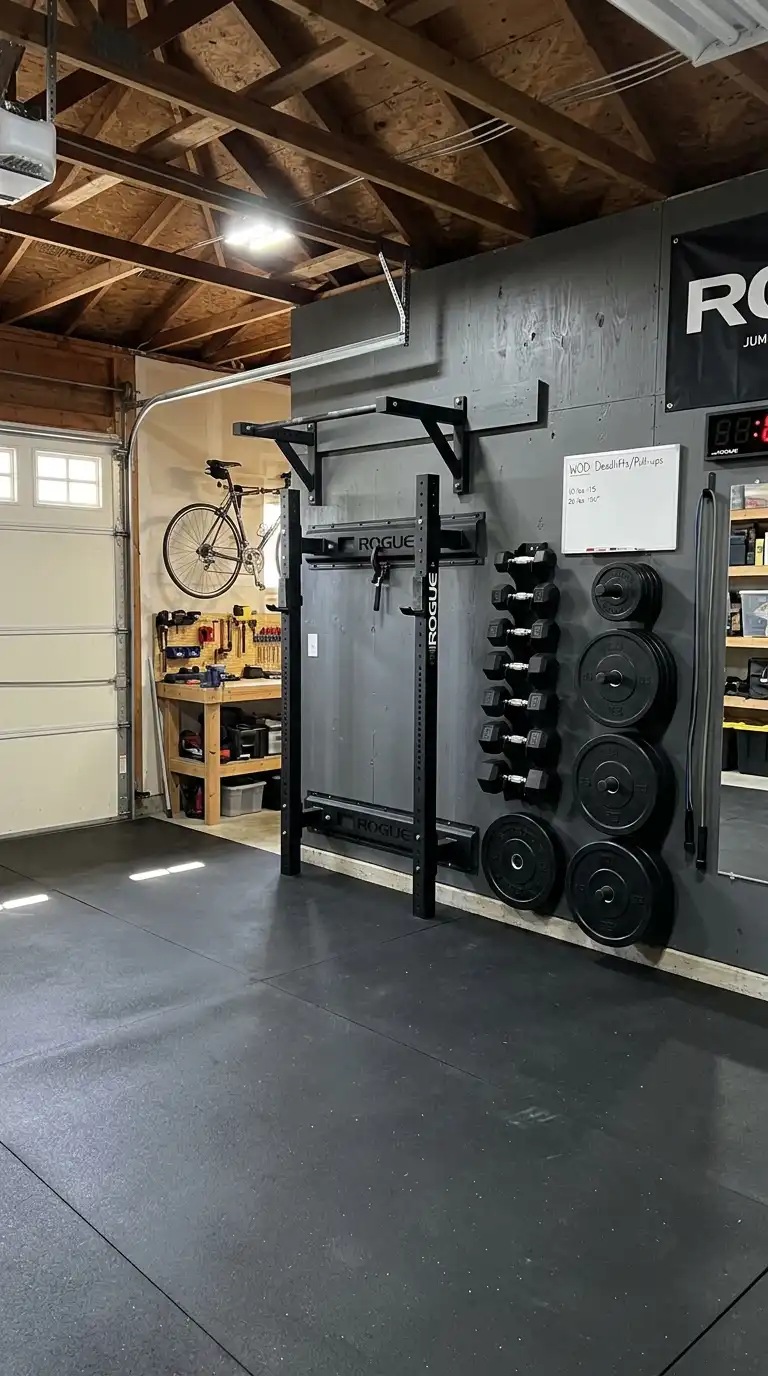
Floor space is at a premium in any garage. Wall-mounted fitness equipment frees up the center of the room while providing essential training tools. A wall-mounted pull-up bar is the foundation of a functional garage gym. Choose a bar that attaches directly to wall studs or to a stringer board mounted across multiple studs. The bar should be high enough that your feet clear the floor when hanging—typically 7 to 8 feet. For taller users, consider a ceiling-mounted bar or a freestanding power rack.
Expand the wall-mounted concept into a full rig. Wall-mounted squat stands, dip bars, and storage pegs for weight plates all attach to a common upright or stringer system. This creates a dedicated workout station that occupies only 12 to 18 inches of floor depth. Brands like Rogue, Titan, and PRx offer wall-folding racks that fold flat against the wall when not in use, reclaiming the garage floor for parking cars. A folding rack is the ultimate space-saving solution for a garage that must still accommodate vehicles. Ensure the wall you mount to has sufficient structural support. Reinforce the mounting area with plywood backers or additional studs as needed. A pull-up bar loaded with dynamic kipping movements generates significant force. Use lag bolts into solid framing.
6. Create a Cardio Zone with Compact Machines
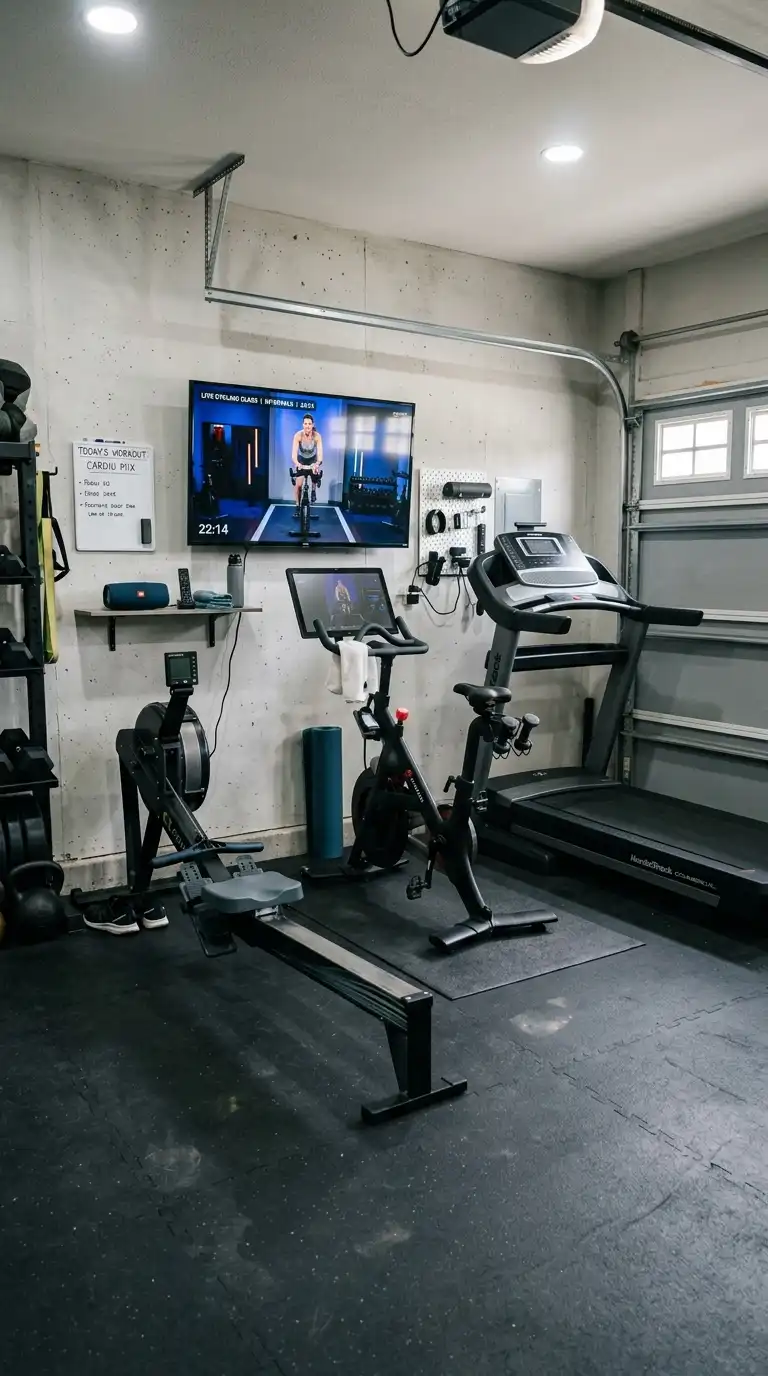
Cardio equipment is bulky, but the garage can accommodate it better than any other room in the house. Designate one corner or wall of the garage as the cardio zone. The most space-efficient cardio machine is a rowing machine, which stores upright when not in use. Treadmills, stationary bikes, and ellipticals have larger footprints but are still viable in a two-car garage if you dedicate one bay to fitness. Folding treadmills reduce the footprint when not in use.
Place cardio machines on rubber flooring to absorb vibration and reduce noise transmitted to the rest of the house. Position them facing a wall rather than the garage door so you are not staring at the door during long workouts. Mount a small television or tablet holder on the wall in front of each machine for entertainment. Consider a fan mounted overhead or a portable floor fan to keep air moving during intense cardio sessions. If you have multiple users, choose machines with adjustable settings for different heights and fitness levels. A spin bike with a Wahoo trainer and a tablet mount offers interactive classes. A curved manual treadmill provides a low-impact, high-intensity option without electricity. The key to the cardio zone is organization. Keep cords off the floor with cable management clips, and store heart rate monitors, water bottles, and towels in a small cart next to the machines.
7. Install Pegboard or Slatwall for Equipment Storage
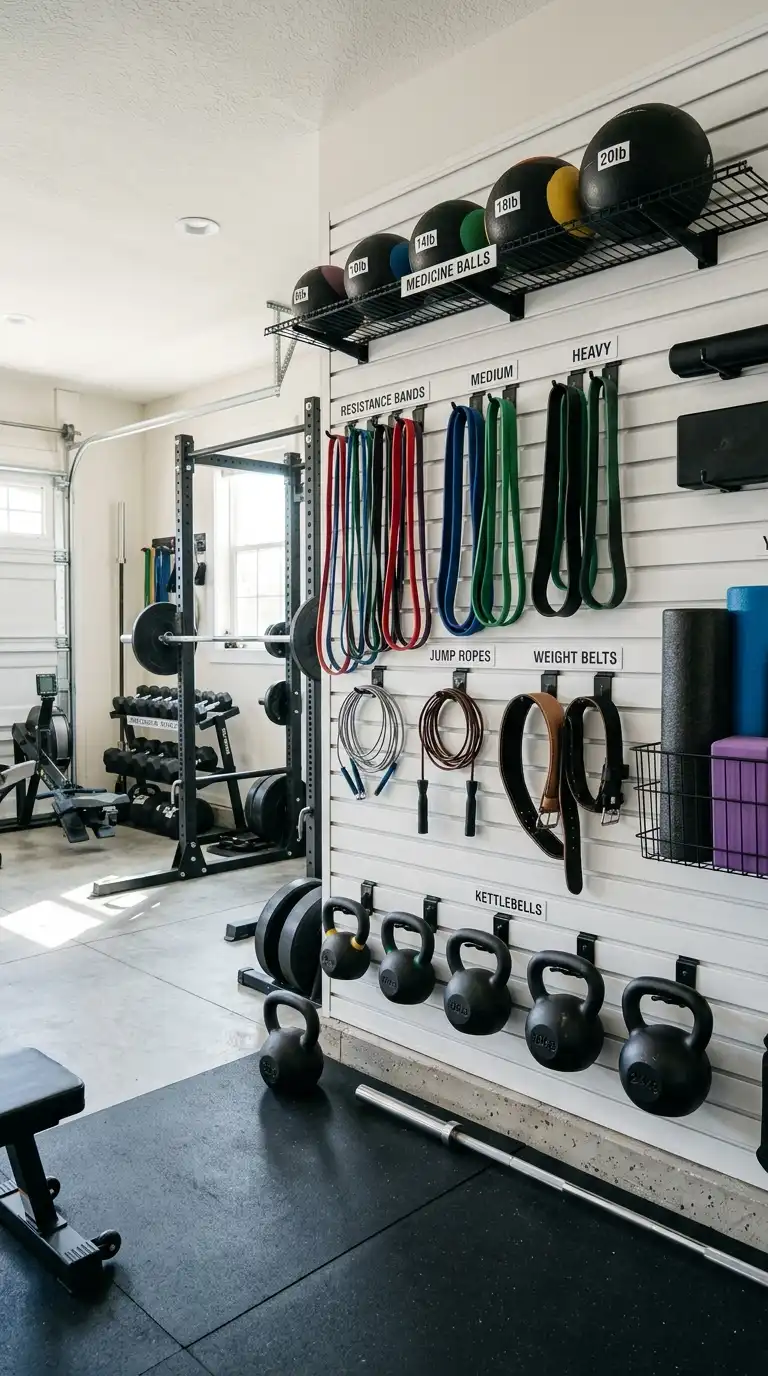
Garage gyms accumulate accessories: resistance bands, jump ropes, ab wheels, yoga blocks, kettlebells, and weight belts. Loose equipment on the floor creates tripping hazards and makes the space feel cluttered. Wall storage solves this problem. Pegboard is the classic solution. A 4×8 foot sheet of hardboard pegboard mounted on furring strips provides hundreds of storage points. Use pegboard hooks of various sizes to hang bands, ropes, belts, and small accessories. Paint the pegboard a bright color like red or blue to add energy to the room.
Slatwall is a more modern and robust alternative. Slatwall panels have horizontal grooves that accept specialized hooks, shelves, and bins. Slatwall is made of MDF, aluminum, or PVC. It holds more weight than pegboard and looks more finished. Install slatwall on an entire wall or on a single section near the workout area. Use it to store kettlebells on horizontal bars, weight plates on plate pegs, and foam rollers on large hooks. For heavy items like sandbags or medicine balls, use slatwall shelves. Label storage locations to make returning equipment easy and to ensure everything has a home. Good storage is not just about organization; it is about safety. A garage gym with clear floors and secured equipment is a garage gym where no one trips over a misplaced dumbbell.
8. Add a Yoga and Stretching Nook
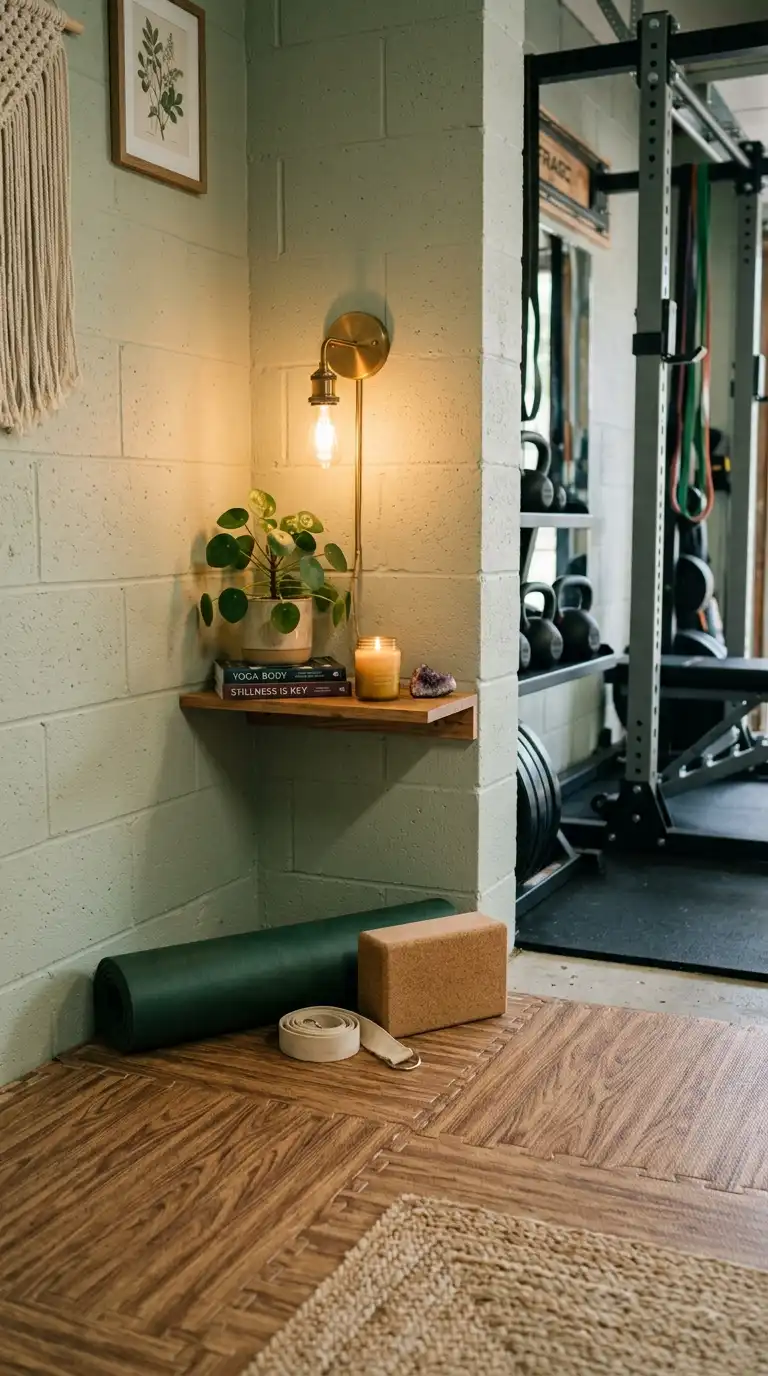
Not every workout is about heavy weights and high heart rates. Flexibility, mobility, and recovery are essential parts of any fitness regimen. Dedicating a corner of the garage to yoga and stretching creates a mental and physical transition from high-intensity work to recovery work. The stretching nook needs only a small footprint—about 6×6 feet is sufficient.
Cover the floor in this area with a softer surface than the main gym floor. Thick yoga mats, interlocking foam tiles, or a padded carpet remnant work well. Keep the temperature slightly warmer in this area if possible, as cold muscles do not stretch well. Add a small space heater or direct a HVAC vent toward the nook. The lighting should be dimmable and warmer in color temperature—around 2700K to 3000K. Install a dimmer switch so you can lower the lights for cool-down stretches and meditation. Add a small shelf or cubby for yoga blocks, straps, bolsters, and a blanket. Consider a wall-mounted tablet holder for following along with yoga videos. A small essential oil diffuser or a white noise machine can enhance the relaxation experience. The stretching nook should feel distinct from the rest of the gym. A different wall color, a fabric hanging divider, or a simple room screen can separate it visually from the weights and cardio machines.
9. Install a Sound System and Television
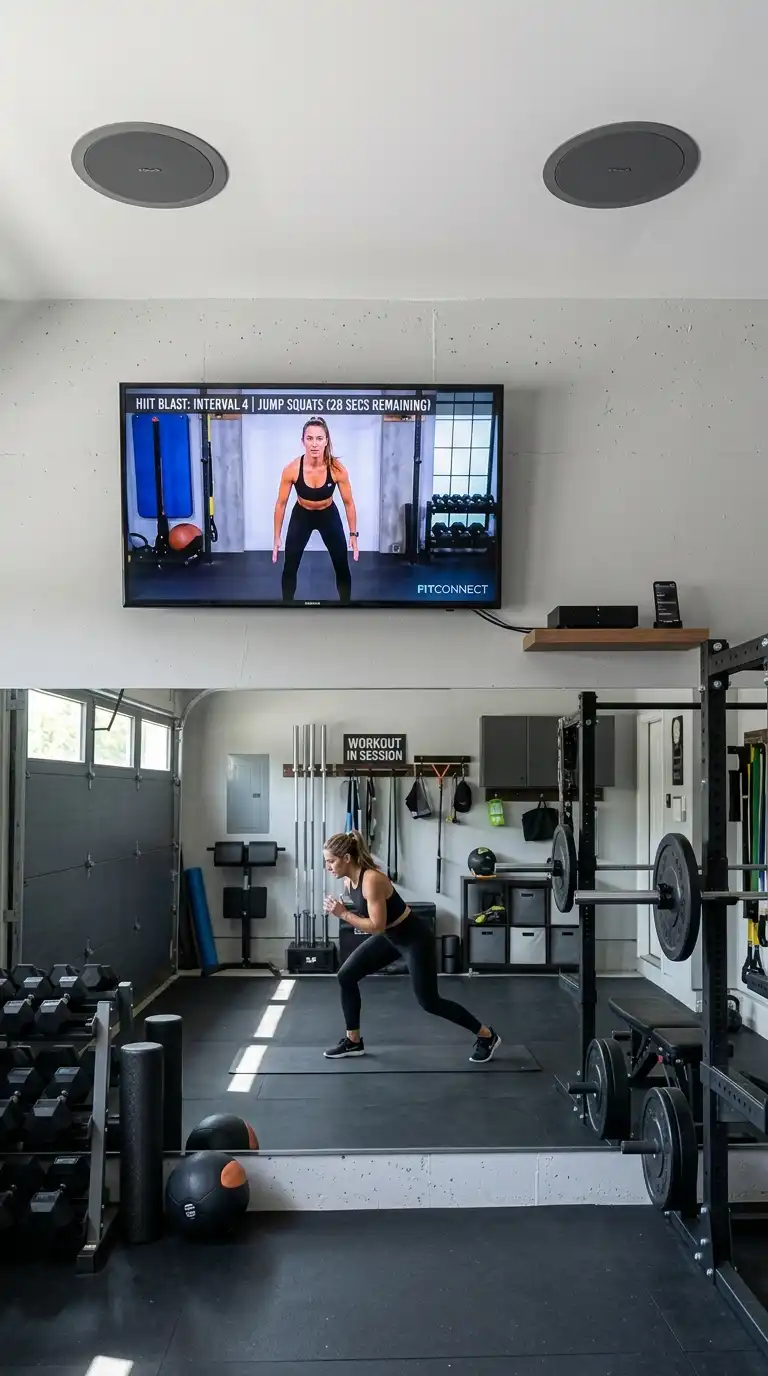
Motivation during workouts often comes from music, podcasts, or instructional videos. A dedicated sound system elevates the garage gym experience. The simplest option is a Bluetooth speaker on a shelf. For better sound quality and coverage, install in-ceiling or wall-mounted speakers connected to a receiver. Outdoor-rated speakers are moisture-resistant and well-suited to the garage environment. Position speakers at opposite corners of the room for stereo sound that reaches every workout zone.
A wall-mounted television is equally valuable. Use it for streaming workout classes, following along with trainer-led videos, or watching entertainment during long cardio sessions. Mount the television high on the wall to keep it out of the way of equipment and to be visible from multiple angles. A 43-inch to 55-inch screen works well in a two-car garage. Protect the television from dust and vibration by mounting it securely and covering it when not in use. Some garage gym owners install a projector and pull-down screen for an immersive workout experience. Whatever audio-visual setup you choose, ensure all wiring is secured to the walls or ceiling to prevent tripping hazards. Use cord covers or conduit for a clean, professional appearance.
10. Paint the Walls and Ceiling an Energizing Color
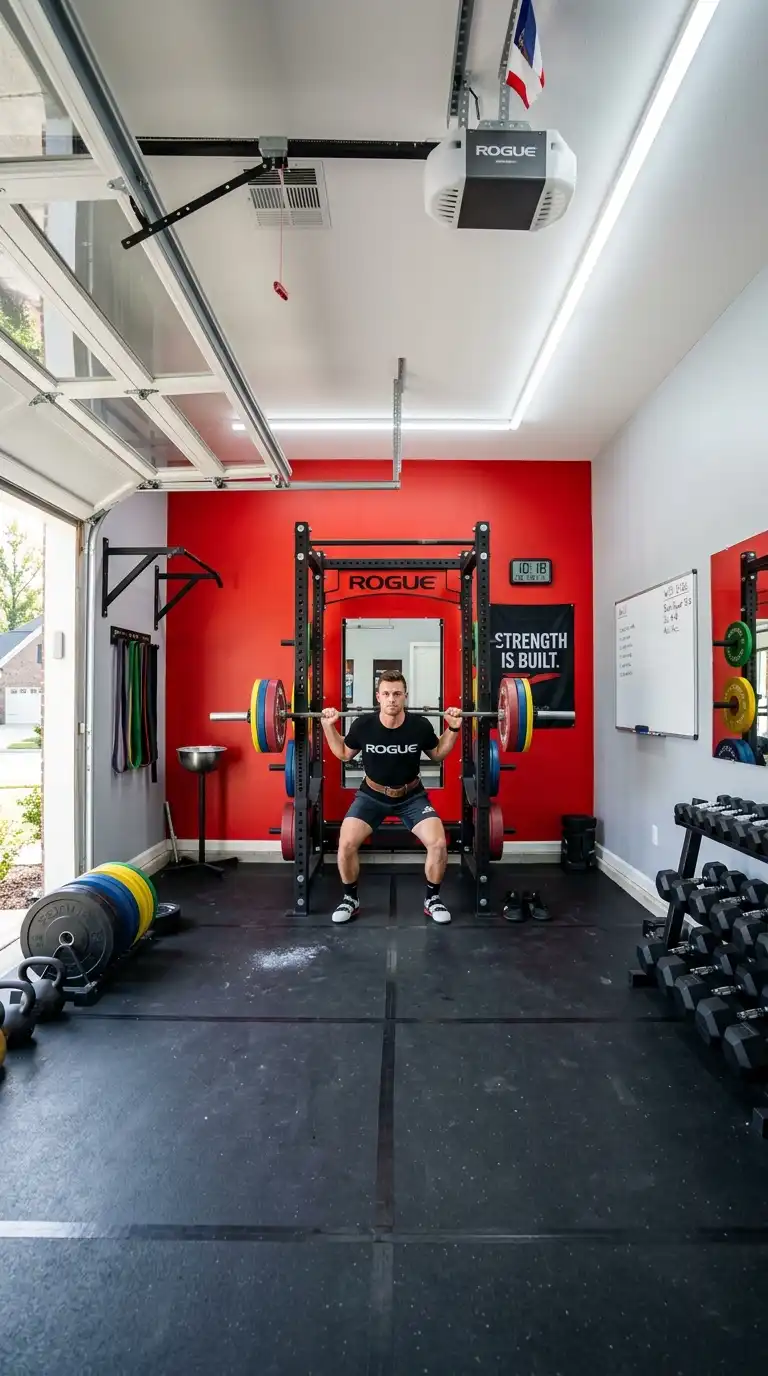
Standard garage walls are unfinished drywall, bare studs, or faded white paint. None of these are motivating. A fresh coat of paint in an energizing color transforms the psychology of the space. Color psychology suggests that certain hues enhance athletic performance. Red increases heart rate and energy. Orange boosts enthusiasm. Yellow stimulates optimism. Blue promotes focus and calm for yoga and stretching. Green reduces eye strain and creates a sense of balance.
For most garage gyms, an accent wall in a bold color paired with neutral gray or white on the other walls works well. Paint the wall behind the squat rack or the cardio zone in a vibrant red or orange. Paint the stretching nook in a calming blue or green. Paint the ceiling white or light gray to reflect light and make the room feel taller. If your garage has exposed rafters or an unfinished ceiling, painting everything a uniform dark color (like charcoal or black) makes the mechanical elements disappear visually. Use high-quality satin or semi-gloss paint that resists moisture and is easy to wipe clean. Epoxy floor paint is another option for the garage floor itself, though it should be covered with rubber mats in the workout areas. The investment in paint is minimal compared to equipment, but the psychological impact is enormous.
11. Add Ventilation and Air Circulation
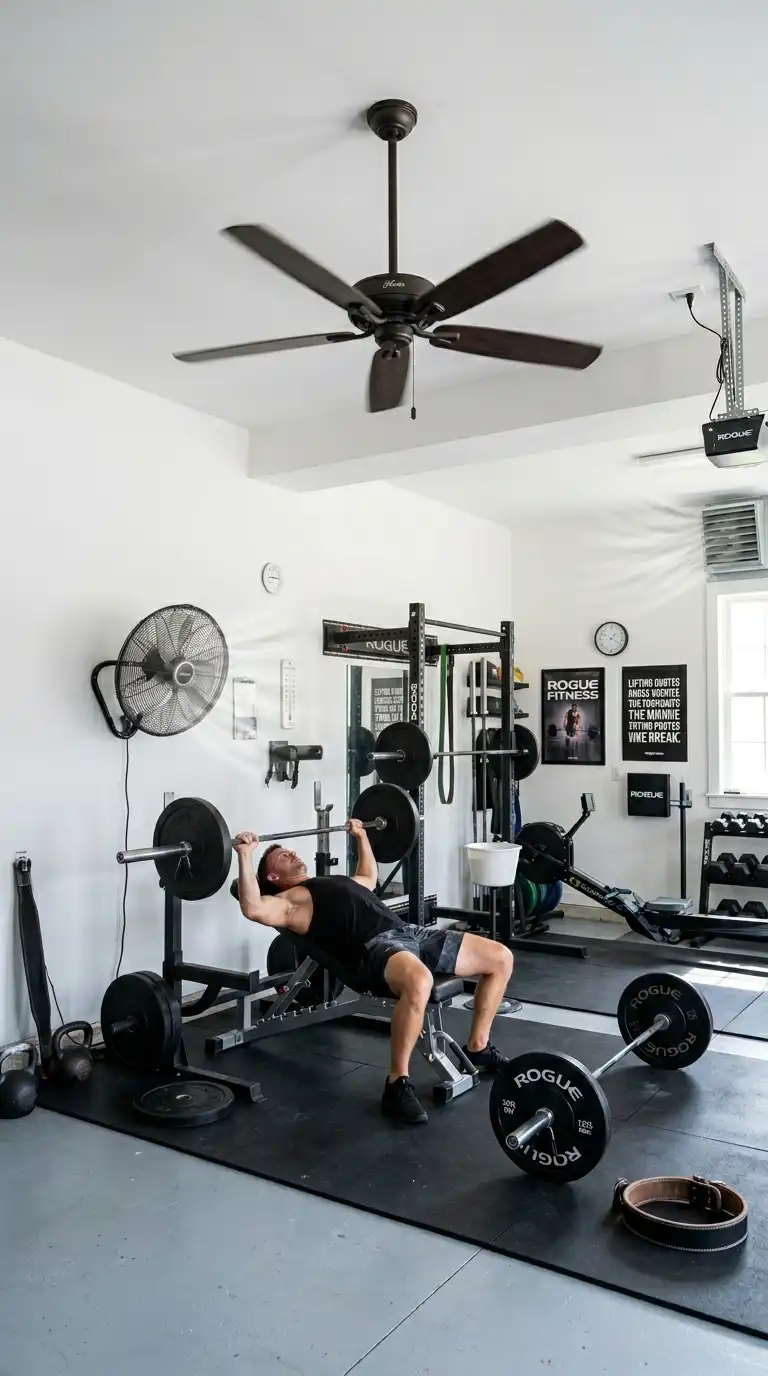
Garage gyms get hot, humid, and stuffy. Sweat, heavy breathing, and lack of fresh air create an unpleasant environment. Proper ventilation is essential for comfort and health. The simplest solution is a large floor fan or two pointed at the main workout areas. Wall-mounted oscillating fans save floor space and provide consistent airflow. Ceiling fans are excellent for general air circulation but must be mounted at a safe height—at least 7 feet from the floor.
For more serious ventilation, install an exhaust fan that vents to the outside. A bathroom exhaust fan rated for continuous operation works well. Position it high on a wall or in the ceiling opposite the main air intake source (like a cracked window or the gap under the garage door). Run the exhaust fan during and after workouts to remove humidity, odors, and airborne particles. If your garage has windows, open them during workouts and install window fans to create cross-breezes. A dehumidifier is valuable in humid climates to prevent mold and mildew on equipment and flooring. Position it near the drain or empty the collection tank regularly. Air purifiers with HEPA filters capture dust, dander, and chalk particles, improving air quality for users with allergies or asthma.
12. Create a Hydration and Towel Station
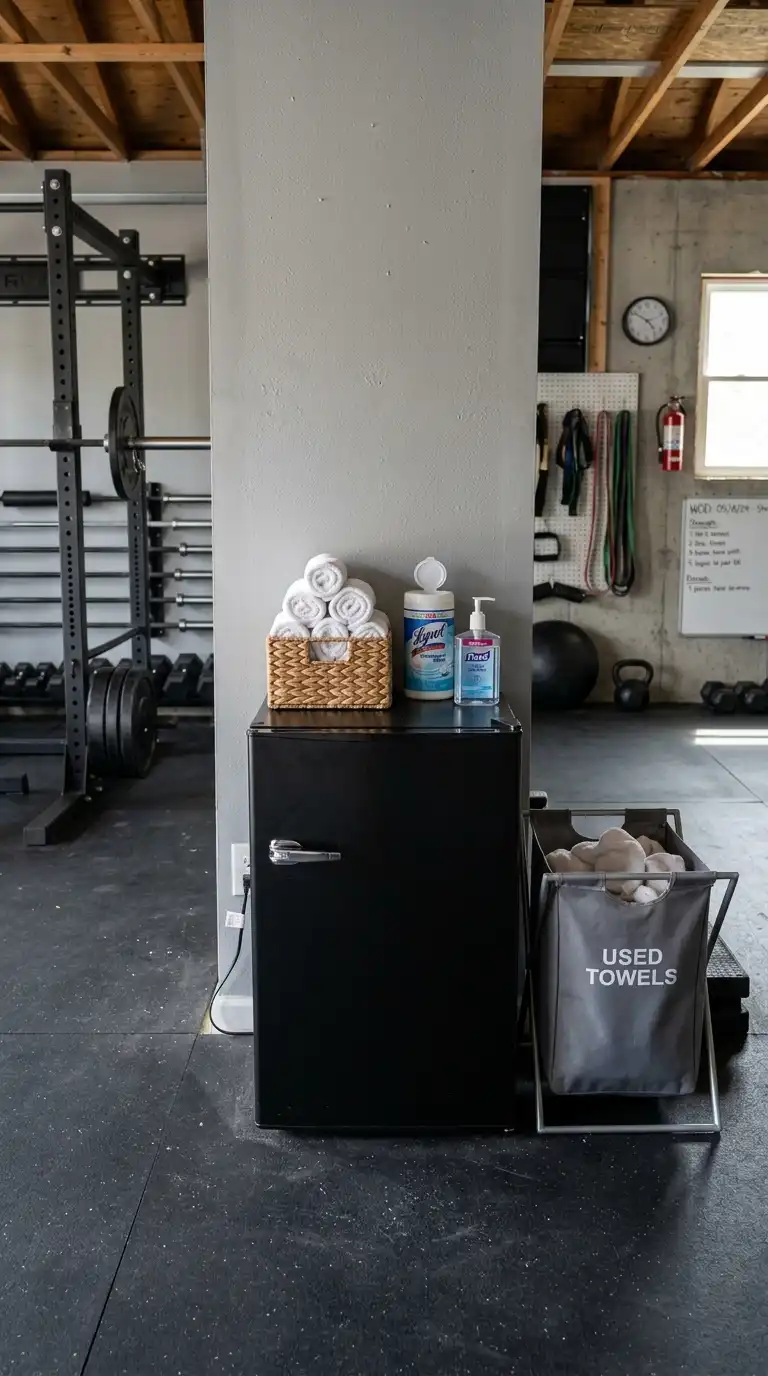
Exercise requires hydration and sweat management. A dedicated station for water and towels keeps the gym organized and prevents you from tracking sweat and moisture through the house. The simplest hydration station is a small refrigerator or mini-fridge stocked with water bottles, sports drinks, and cold towels. Place it near the entrance of the garage gym for easy access without walking through the workout area.
On top of the fridge, set up a towel dispenser or a basket of clean towels. A small hamper or laundry basket next to the station collects used towels. Add a wall-mounted paper towel dispenser for cleaning equipment between uses. A hand sanitizer pump and disinfectant wipes keep surfaces clean. For a more advanced setup, install a small utility sink with a hose attachment for filling water bottles and cleaning equipment. The hydration station does not need to be elaborate, but it needs to be convenient. If water is hard to access, you will skip it. Make it the first thing you see when you walk in and the last thing you pass when you leave.
Key Elements for a Garage Exercise Room
Climate control: Insulation and HVAC for year-round comfort. Flooring: Rubber mats or rolls to protect concrete and joints. Lighting: Bright, layered, and cool-temperature LED fixtures. Mirrors: Large wall mirrors for form checking. Wall storage: Pegboard or slatwall for accessories and equipment. Space planning: Dedicated zones for strength, cardio, and stretching. Ventilation: Fans, exhaust, and dehumidifiers for air quality. Amenities: Sound system, television, hydration station, and towel storage.
Conclusion
Converting a garage into an exercise room is one of the smartest home improvements you can make. You gain a dedicated fitness space without the monthly cost of a gym membership or the commute time. You can work out in your own clothes, at your own schedule, with your own music. The garage’s natural advantages—separate entrance, high ceilings, concrete floor, and distance from living spaces—make it superior to any spare bedroom conversion. Whether you choose to insulate the garage door and walls, install rubber flooring, add bright layered lighting, mount a large wall mirror, build a wall-mounted pull-up bar and rig, create a cardio zone, install pegboard or slatwall for equipment storage, add a yoga and stretching nook, install a sound system and television, paint the walls an energizing color, add ventilation and air circulation, or create a hydration and towel station, the key is making the space functional, motivating, and comfortable. With these twelve garage exercise room ideas, you can stop parking your car in the garage and start parking your fitness goals there instead.