Skip to content


piccolo major scales are the foundation for playing melodies, arpeggios, and other advanced techniques on the piccolo. In this article, we will provide a comprehensive guide on piccolo scales, from basic to advanced, and help beginners to start their journey on the right foot. You can download a PDF sheet of all the piccolo major, minor and chromatic scales from here.
What are scales?
Scales are a set of notes arranged in ascending or descending order, typically played in a specific pattern. Scales are essential for every musician, including piccolo players, as they form the foundation of melody and harmony. The piccolo scales can be challenging to learn, especially for beginners, but with proper practice and dedication, anyone can master them.
Basic scales and arpeggios
Diatonic scales
- Ionian mode scales for piccolo (major scales)
- Dorian mode scales for piccolo
- Phrygian mode scales for piccolo
- Lydian mode scales for piccolo
- Mixolydian mode scales for piccolo
- Aeolian mode scales for piccolo (minor scales)
- Locrian mode scales for piccolo
More advanced scales
- Major pentatonic scales for piccolo
- Minor pentatonic scales for piccolo
- Blues scales for piccolo
Major Scales
A major scale is a sequence of notes played in a specific order, using a particular pattern of whole steps (W) and half steps (H). The pattern for a major scale is as follows: W-W-H-W-W-W-H. For example, the C major scale consists of the following notes: C-D-E-F-G-A-B-C. You will get the finger placement chart of all the piccolo major scales from here.


Minor Scales: Natural, Harmonic, and Melodic
Minor scales are another essential set of scales that every piccolo player must learn. There are three types of minor scales
- Natural Minor Scale: This is also called the Aeolian mode, and it is based on the sixth degree of the major scale. The pattern is W-H-W-W-H-W-W, where W represents a whole step and H represents a half-step. For example, A natural minor scale would be A-B-C-D-E-F-G-A.
- Harmonic Minor Scale: This scale has a raised seventh degree, which makes it different from the natural minor scale. The pattern is W-H-W-W-H-3H-H, where 3H represents three half-steps. For example, A harmonic minor scale would be A-B-C-D-E-F-G#-A.
- Melodic Minor Scale: This scale has a raised sixth and seventh degree when ascending, but it is the same as the natural minor scale when descending. The pattern is W-H-W-W-W-W-H, where W represents a whole step and H represents a half-step. For example, A melodic minor scale would be A-B-C-D-E-F#-G#-A ascending and A-G-F-E-D-C-B-A descending.


Chromatic Scales
The chromatic scale is a scale that includes all the twelve pitches, in a sequence of half-steps. It’s an essential scale for developing finger dexterity, and it helps in understanding the relationship between notes. Here’s how to play the chromatic scale on the piccolo:
- C Chromatic Scale: C-C#-D-D#-E-F-F#-G-G#-A-A#-B-C


Pentatonic Scales
Pentatonic scales are five-note scales that are used in many cultures around the world. They are often used in improvisation and solo playing, and they are great for developing finger dexterity and ear training. The two most common pentatonic scales are the major and minor pentatonic scales. Here’s how to play them on the piccolo:
- Major Pentatonic Scale: C-D-E-G-A-C
- Minor Pentatonic Scale: A-C-D-E-G-A
Blues Scale
The blues scale is a six-note scale that is often used in blues music. It is a minor pentatonic scale with an added flat fifth. Here’s how to play the blues scale on the piccolo:
- Blues Scale: C-Eb-F-F#-G-Bb-C
Whole Tone Scale
The whole-tone scale is a six-note scale that consists of only whole steps. It is often used in modern and contemporary music, and it can be challenging to play on the piccolo. Here’s how to play the whole-tone scale on the piccolo:
- Whole Tone Scale: C-D-E-F#-G#-A#
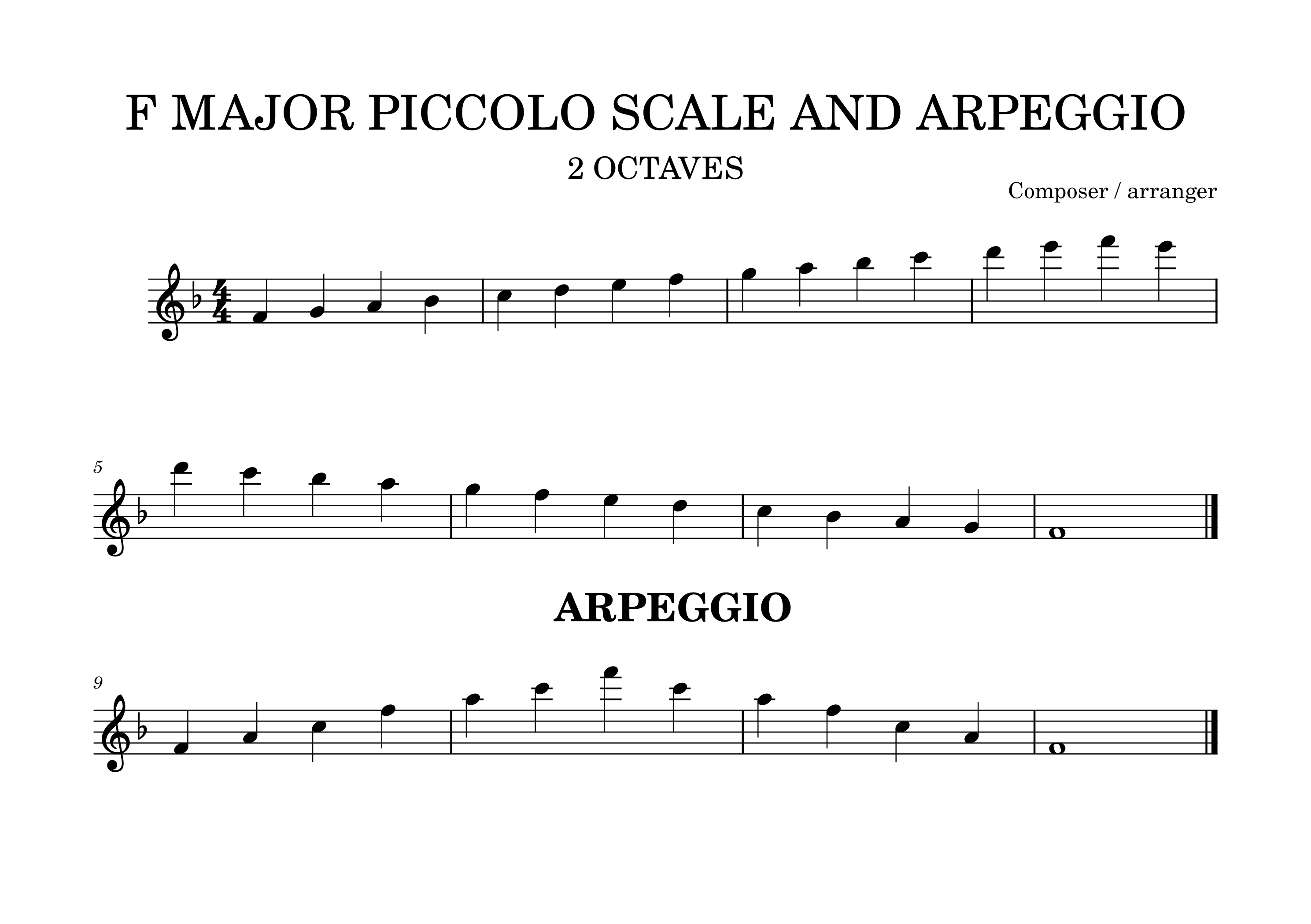
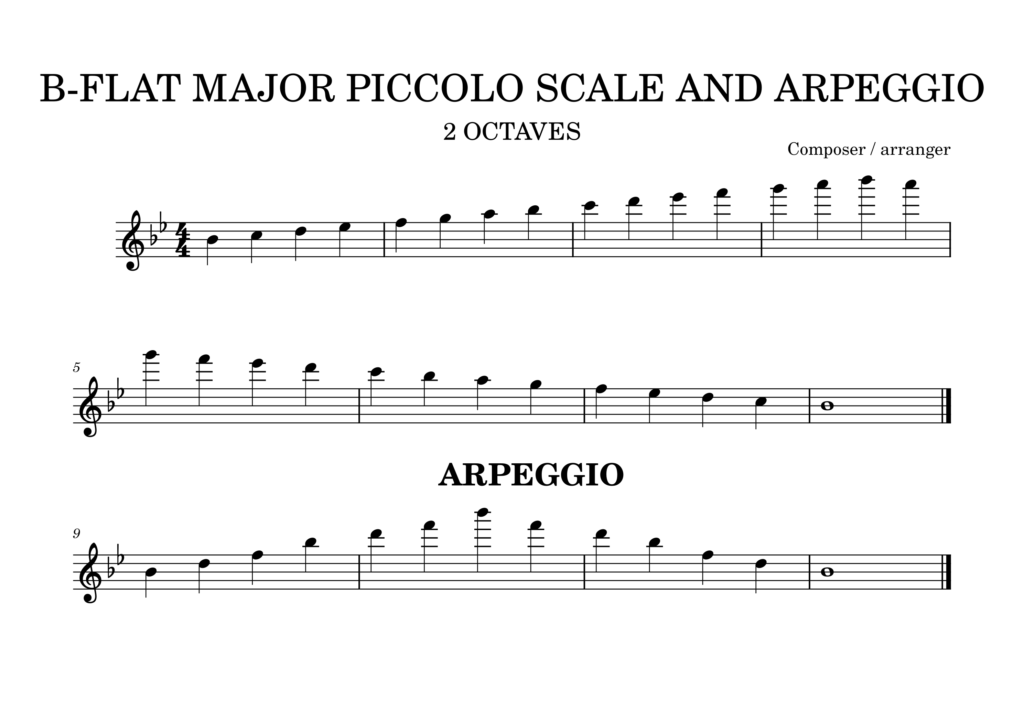
Basic piccolo Scales For Beginners: C, G, D, F, Bb Major Scales
The major scales are the most common scales in Western music, and they are the foundation for all other scales. The basic piccolo scales are the C, G, D, F, and Bb Major scales. These scales are the starting point for all beginners, and it’s essential to learn them thoroughly. Here’s how to play each of these scales:
- C Major Scale: C-D-E-F-G-A-B-C
- G Major Scale: G-A-B-C-D-E-F#-G
- D Major Scale: D-E-F#-G-A-B-C#-D
- F Major Scale: F-G-A-Bb-C-D-E-F
- Bb Major Scale: Bb-C-D-Eb-F-G-A-Bb
Scale Practice Tips and Techniques
Practicing piccolo scales can be boring and repetitive, but it is essential for developing technique and improving overall playing. Here are some tips and techniques for practicing piccolo scales:
- Start slow and gradually increase the tempo
- Practice with a metronome to improve rhythm
- Practice in different octaves to improve finger dexterity
- Practice with different articulations, such as legato and staccato
- Practice with different dynamics, such as piano and forte
Why are scales important for piccolo players?
Scales are fundamental to every musician, as they help in developing finger dexterity, intonation, and overall technique. Learning piccolo scales is crucial for developing a strong foundation for playing melodies, arpeggios, and other advanced techniques. Practicing piccolo scales also helps in improving breath control, tone quality, and rhythm. Scales are also essential for developing a good ear, as they help in identifying intervals and developing the relative pitch.
piccolo Scale Exercises for Beginners
Here are some beginner exercises that can help in practicing piccolo scales:
- Play each major scale in quarter notes, eighth notes, and sixteenth notes, gradually increasing the tempo.
- Play the chromatic scale in half notes, quarter notes, and eighth notes, starting from the lowest note on the piccolo and going up to the highest note.
- Play the major and minor pentatonic scales in quarter notes, eighth notes, and sixteenth notes, gradually increasing the tempo.
Advanced piccolo Scale Techniques: Double Tonguing, Triple Tonguing, and Vibrato
Once you have mastered the basics of piccolo scales, you can start learning advanced techniques such as double tonguing, triple tonguing, and vibrato. These techniques can add depth and complexity to your playing, but they require patience and practice to master.
- Double Tonguing: This is a technique that involves using the tongue to articulate two notes in quick succession. It is often used in
- fast and technical passages. To double tongue, use a “tuh-kuh” or “duh-guh” syllable pattern, where the “t” or “d” represents the first note and the “k” or “g” represents the second note. Practice double tonguing with scales in a slow and steady tempo, gradually increasing the speed.
- Triple Tonguing: This is similar to double tonguing but involves articulating three notes in quick succession. The syllable pattern is “tuh-kuh-tuh” or “duh-guh-duh”. Practice triple tonguing with scales in a slow and steady tempo, gradually increasing the speed.
- Vibrato: This is a technique that involves varying the pitch of a note slightly to add warmth and expression to the sound. To practice vibrato, start with a sustained note and use a gentle back-and-forth motion with the jaw to create a fluctuation in pitch. Gradually increase the speed and depth of the vibrato.
Conclusion
In conclusion, piccolo scales are an essential part of piccolo playing and are fundamental for developing technique, ear training, and overall musicianship. There are many different types of scales that can be played on the piccolo, including major and minor scales, pentatonic scales, blues scales, and whole-tone scales. Practicing piccolo scales can be challenging and tedious, but it is essential for improvement. With practice, patience, and dedication, mastering piccolo scales can lead to a lifetime of musical enjoyment and fulfillment.
FAQs
- How often should I practice piccolo scales? It is recommended to practice scales for at least 10-15 minutes every day to see improvement.
- Do I need to learn all types of scales to become a good piccolo player? No, mastering the basic major and minor scales is essential, but learning additional scales can add depth and variety to your playing.
- How can I make scale practice more interesting? Try practicing with different articulations, dynamics, and tempos, and challenge yourself to play in different keys and octaves.
- What is the best way to improve my technique when playing scales? Start slow and gradually increase the tempo, practice with a metronome, and focus on the evenness and clarity of each note.
- How long does it take to master piccolo scales? Mastery of scales is an ongoing process, and it can take years of practice to achieve true mastery. However, with consistent and dedicated practice, improvement can be seen in a matter of weeks or months.