Skip to content
 “D sharp” is a musical note, which is a halftone higher in pitch than “D” and a halftone lower in pitch than “E” in the Western musical scale. It is denoted by the letter “D#” in sheet music and can be played on various musical instruments, such as the piano, guitar, and piccolo.
D sharp piccolo finger placement chart
What is D sharp on the piccolo?
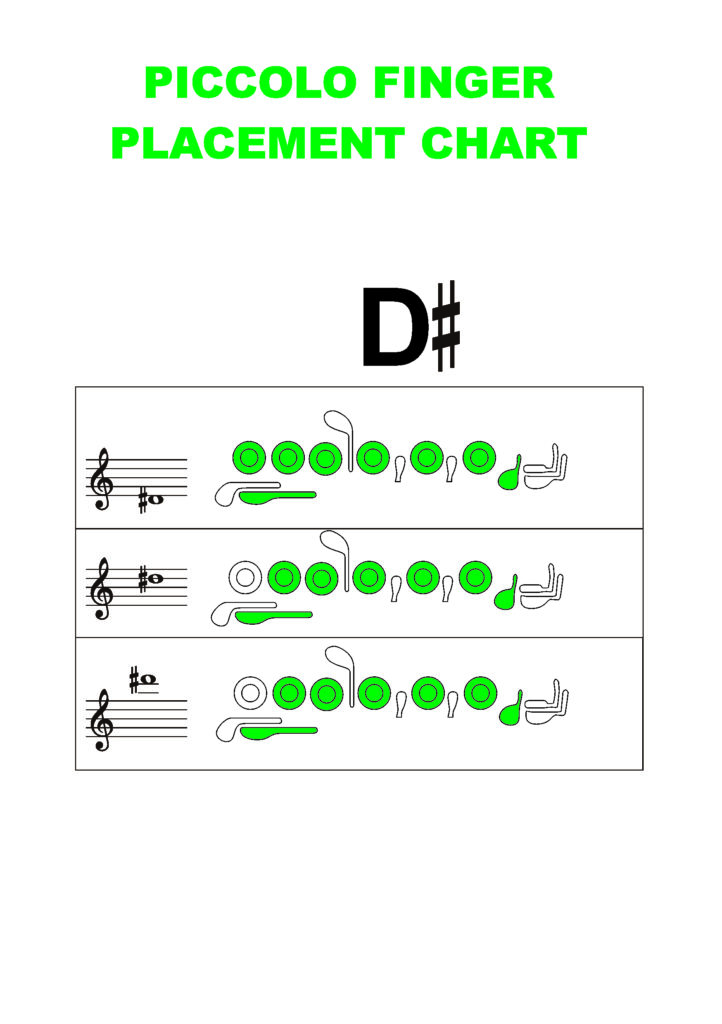
On the piccolo, D sharp is the same as E flat note, meaning that you can use the same finger placement for E flat to play a D sharp note. The D sharp is a semitone lower than E natural and a semitone higher than D natural. On the piccolo also, D sharp can be found at three different ranges of a piccolo musical staff and they include D#4, D#5, and D#6.
How to play D sharp on the piccolo: finger placement and placement
To play D sharp on the piccolo, you have to consider the position of that D sharp on the staff or consider the range of that D sharp. There are three ranges of D sharp on the piccolo and their finger placements include:
Low D sharp piccolo finger placement chart (First ledger space below the treble staff)
To play the lowest D sharp on the piccolo, you need to:
- close every key that is meant to be closed with your right finger except for the G sharp lever that is closed with the left little finger.
- press the B key with your left thumb.
- press every key that the right index finger, middle finger, and ring finger are supposed to close.
- then press the D sharp lever key your right little finger.

Middle D sharp piccolo finger placement chart (Fourth line of the treble staff)
To play the middle D sharp on the piccolo, you need to;
- open the key that is meant to be closed with your left index finger and close the keys meant to be closed with your left middle finger and ring finger.
- press the B key with your left thumb.
- close every key that the right index finger, middle finger, and ring finger are supposed to close.
- then press the D sharp lever with your right little finger.

High D sharp piccolo finger placement chart (Fourth line of the treble staff)
If you want to know how to play high D sharp on piccolo, you need to;
- open the key that is meant to be closed with your left index finger and close the keys meant to be closed with your left middle finger and ring finger.
- press the B key with your left thumb.
- close every key that the right index finger, middle finger, and ring finger are supposed to close.
- then press the D sharp lever with your right little finger.
- You can alternatively press the G sharp lever with your left little finger after doing everything mentioned above.

D sharp to E natural trill on piccolo
To play D sharp to E trill on the piccolo, use the piccolo trill finger placement chart below:

What is a D sharp roller on the piccolo?
A “D sharp roller” on a piccolo is a mechanism that some piccolos have to make it easier to play the note D# (D sharp) by rolling a small wheel or button with the little finger of the left hand. This mechanism is located on the piccolo’s left-hand little-finger key, and it works by closing an additional hole on the instrument, which changes the pitch of the note D. The D# roller is not present on all piccolos, and its use is a matter of personal preference for the flutist. Some flutists find it helpful for playing fast passages or for achieving a more consistent tone on note D#.

D sharp major scale for piccolo
The D sharp Major Scale is a musical scale that consists of the notes D#, E#, Fx, G#, A#, B#, and Cx. It is a major key and is also enharmonically equivalent to the key of E flat (E♭) major, which means that the two keys sound the same in terms of pitch, but are spelled differently. In Western music, the D sharp major scale is not used as frequently as some other keys, such as C major or G major, but it is still an important key for certain types of music, such as classical or jazz.
D sharp is the key of 9 sharps. The D sharp major scale consists of the notes D#, E#, Fx, G#, A#, B#, and Cx, which all have a sharp symbol (#) in their names. In Western music theory, the number of sharps or flats in a key signature is used to indicate which notes are raised or lowered in a given key. The key of D sharp major, with its 9 sharps, is one of the less common keys in Western music and is generally considered to be a more challenging key to play and compose in, due to the complexity of its key signature.
D sharp Punam piccolo price (D sharp medium right-hand bamboo piccolo)
A D sharp medium right-hand bamboo piccolo is a type of piccolo made from bamboo that is designed to play notes in the key of D sharp (D#). The term “medium” usually refers to the length and thickness of the piccolo, which can affect the sound and playability of the instrument. The term “right hand” refers to the placement of the finger holes on the piccolo, with the right hand typically used to play the higher notes. The price of this D sharp Punam piccolo is about ₹2,000 which is equivalent to $25.
Bamboo piccolos are a popular type of instrument in many musical traditions, including Indian classical music, folk music, and world music. They are generally lightweight, affordable, and easy to play, making them a good choice for beginners or for anyone looking to experiment with different types of music. If you are interested in learning to play a D sharp medium right-hand bamboo piccolo, you may want to consider taking lessons from a qualified teacher or using instructional materials designed specifically for bamboo piccolos.

D sharp minor piccolo music
| Title | Composer | Instruments |
| Caprice No. 14 in D-sharp minor from 26 Little Caprices, Op. 37 | J. Andersen | piccolo solo |
| Study No. 14 in D-sharp minor from 24 Technische Studien, Op. 11 | E. Prill | piccolo solo |
| Study No. 14 in D-sharp minor from 24 Etudes mélodiques, Op. 110 | C. Kummer | piccolo solo |
| Study No. 14 in D-sharp minor from 24 Etudes for piccolo, Op. 30, Op. 30 | J. Andersen | piccolo solo |
| Study No. 14 in D-sharp minor from 24 Etudes for piccolo, Op. 15, Op. 15 | J. Andersen | piccolo solo |
| Study No. 14 in D-sharp minor from 24 Etudes for piccolo, Op. 33, Op. 33, No. 14 | J. Andersen | piccolo solo |
| Study No. 14 in D-sharp minor from 24 Etüden zur Förderung der Technik, Op. 12 | E. Prill | piccolo solo |
| Study No. 14 in D-sharp minor from 26 Exercises, Op. 107 | A.B. Fürstenau | piccolo solo |
| Study No. 14 in D-sharp minor from 30 Etüden in Allen Tonarten, Op. 6 | E. Prill | piccolo solo |
| Study No. 14 in D-sharp minor from Exercices journaliers pour la flûte, Op. 71 | A. Terschak | piccolo solo |
| Study No. 20 in D-sharp minor from Méthode pour la flûte | L. Drouet | piccolo solo |
| Study No. 8 in D-sharp minor from Studi per il flauto | N. Dôthel | piccolo solo |