Skip to content
 If you’re looking to learn how to play C sharp on the piccolo, this guide is for you. From proper finger placement to breath control, we’ll cover everything you need to know to master this note.
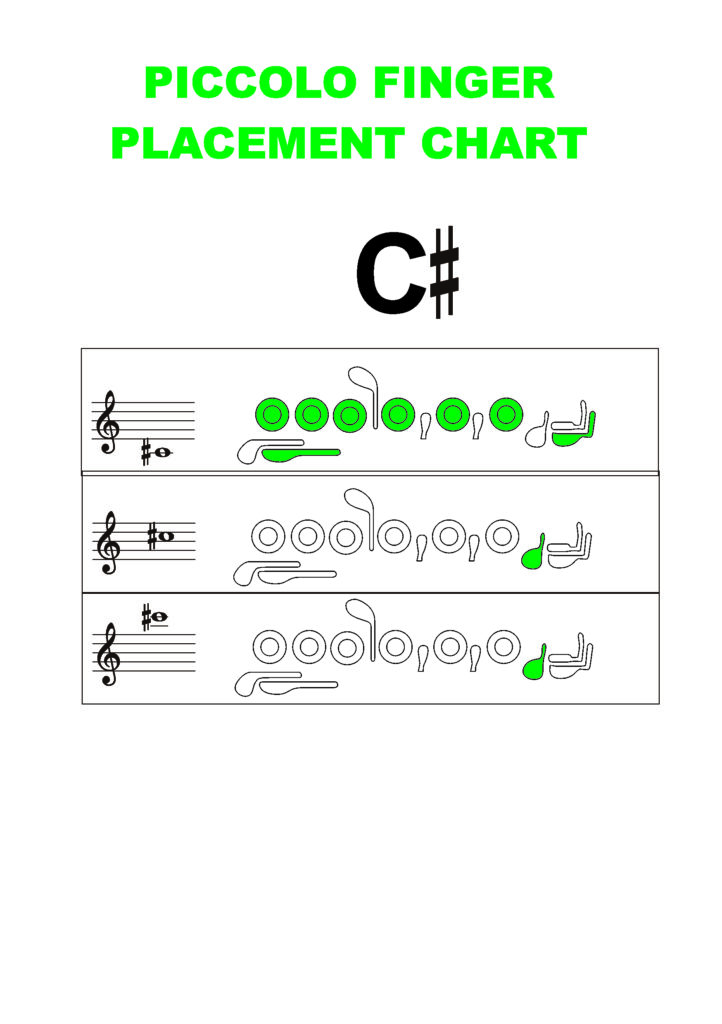
C sharp piccolo finger chart
What is C sharp on the piccolo?
C sharp is a note that is a semitone higher than the C natural and a semitone lower than the D natural note. The C sharp on the piccolo shares the same finger placement with the D flat note on the piccolo. There are possible three C sharps on C piccolos. It’s worth noting that the exact finger placements for different notes on the piccolo can vary slightly depending on the specific type of piccolo and the player’s individual technique. Additionally, the written note “C sharp” may be represented by different symbols in different musical contexts, such as a “#” symbol or the letter “C” with a small vertical line next to it.
How to play C sharp on the piccolo: finger placement and placement
To play C sharp on the piccolo, you have to consider the position of that C sharp on the staff or consider the range of that C sharp. There are three ranges of C sharp on the piccolo and their finger placements include:
Low C sharp piccolo finger placement (First ledger line below the treble staff)
To play the lowest C sharp on the piccolo, you need to;
- close every key that is meant to be closed with your right finger except for the G sharp lever that is closed with the left little finger.
- press the B key with your left thumb.
- press every key that the right index finger, middle finger, and ring finger are supposed to close.
- then press the roller key with your right little finger.

Middle C Sharp piccolo finger placement (Third space of the treble staff)
To play the middle C sharp on the piccolo, you need to;
- open every key that is meant to be closed with your right fingers.
- don’t press the B key with your left thumb.
- open every key that the right index finger, middle finger and ring finger is supposed to close.
- then press the roller key with your right little finger.

Ledger Line C Sharp piccolo finger placement (Second ledger line above the treble staff)
To play the ledger C sharp on the piccolo, you need to;
- open every key that is meant to be closed with your right finger.
- don’t press the B key with your left thumb.
- open every key that the right index finger, middle finger, and ring finger are supposed to close.
- then press the roller key with your right little finger.

C Sharp Major piccolo Scale

Is there a C sharp piccolo? Yes there is a C sharp piccolo and it is a Punam piccolos C Sharp medium right hand bansuri that measures about 18.5 inches long. The price of this piccolo The “C Sharp” designation refers to the key of the piccolo, which is a Western music concept used to describe the pitch of the notes.
In Indian classical music, the bansuri is typically used as a solo instrument or to accompany vocals or other instruments. The right hand bansuri is played by holding the piccolo with the right hand near the blowing end, and using the left hand to cover and uncover the finger holes to create different pitches.
What are the C sharp major piccolo notes and scale?
The C sharp major piccolo notes include C#, D#, E#, F#, G#. A#, B#, C#. These combinations of keys seem tough to play a simple scale on it because almost every note in this scale is sharpened. Mastering the C sharp major scale on the piccolo requires consistent practice and attention to technique. Here are some tips to help you achieve mastery of C sharp piccolo scale:
- Start slowly: Begin by playing the scale slowly, focusing on playing each note clearly and evenly. It’s important to use the correct finger placements and maintain good breath control throughout.
- Use a metronome: Once you can play the scale accurately, gradually increase the speed using a metronome to help you maintain a steady tempo.
- Practice in all octaves: Once you can play the scale in one octave, try playing it in different octaves. This will help you become more comfortable with the finger placements and strengthen your muscle memory.
- Practice ascending and descending: Start by practicing the scale ascending, then try descending. This will help you become comfortable with the finger placements in both directions.
- Pay attention to intonation: The C sharp major scale can be challenging to play in tune due to the nature of the sharps and flats involved.
Techniques for C sharp trill on the piccolo
To play a C sharp trill on the piccolo, check it out here. Meanwhile, to have a clear production you need to follow these steps:
- Start by playing the C sharp note on the piccolo.
- To play the trill, alternate quickly between the C sharp note and the note one half-step higher, which is D.
- To make the trill sound smooth and even, use a combination of finger and air techniques. For example, you can use a “hammer-on” technique with your fingers to quickly switch between the C sharp and D notes, while also using a faster air stream to help the notes sound connected.
- Practice the trill slowly at first, making sure that each note is clear and even. Gradually increase the speed of the trill as you become more comfortable with the technique.
- You can use a specific C# trill key on the piccolo that was designed for this.
Nocturne in C sharp minor for piccolo
The Nocturne in C sharp minor is a famous piano piece by Frédéric Chopin, but it can also be played on other instruments such as the piccolo. To play this piece on the piccolo, you will need to obtain or transcribe the sheet music for piccolo.
Here are some general tips for playing the Nocturne on the piccolo:
- Practice the notes slowly and accurately, paying attention to the correct finger placements and pitch.
- Try to replicate the piano’s phrasing and dynamics on the piccolo. This means playing with expression and using dynamics such as crescendos, diminuendos, and accents to highlight the musical phrases.
- Experiment with different articulations, such as staccato, legato, and slurs, to give the piece more character and texture.
- Use vibrato to add warmth and emotion to the sustained notes in the piece.
- Work on your breathing and breath control, as the Nocturne has many long phrases that require sustained breath support.
Overall, the Nocturne in C sharp minor can be a challenging but rewarding piece to play on the piccolo. With practice and attention to detail, you can bring out the beauty and emotion of Chopin’s music on the piccolo.
piccolo concertos with high C sharp
Many piccolo concertos have middle C sharp passages, as this note is one of the highest notes commonly played on the piccolo. It is very rare to see piccolo concertoes with high C#. Here are a few examples of piccolo concertos with prominent middle C sharp sections:
- Mozart piccolo Concerto No. 1 in G major: The third movement of this concerto features a fast and virtuosic section with a high C sharp in the solo piccolo part.
- Bach piccolo Concerto in A minor: This concerto has a beautiful slow movement that features a sustained high C sharp in the solo piccolo part.
- Vivaldi piccolo Concerto “Il gardellino”: This concerto, also known as “The Goldfinch,” features a high C sharp trill in the third movement.
- Ibert piccolo Concerto: This modern concerto has a challenging cadenza in the first movement that includes high C sharp runs and trills.
When playing a concerto with high C sharp passages, it is important to practice the finger placements and articulations carefully to ensure clean and accurate execution. You should also work on your breath support and tone production, as these notes require a steady and focused airstream to sound clear and in tune. With practice and perseverance, you can master these challenging passages and bring out the beauty and excitement of the concerto.
C sharp major piccolo songs and repertoire
C sharp is a rare key for piccolo music, and there are many beautiful songs and pieces that feature this key. Here are a few examples piccolo songs and repertoire in C sharp major:
| Title | Composer | Instruments |
|---|---|---|
| Study No. 15 in C-sharp major from Exercices journaliers pour la flûte, Op. 71 | A. Terschak | piccolo solo |
| Study No. 15 in C-sharp major from 24 Technische Studien, Op. 11 | E. Prill | piccolo solo |
| Study No. 15 in C-sharp major from 24 Etüden Zur Förderung der Technik, Op. 12 | E. Prill | piccolo solo |
| Study No. 15 in C-sharp major from 30 Etüden in Allen Tonarten, Op. 6 | E. Prill | piccolo solo |
| Study No. 3 in C-sharp major from Studi per il flauto | N. Dôthel | piccolo solo |
When playing these or any other songs in C sharp on the piccolo, it is important to pay attention to intonation, tone quality, and expression. Practice slowly and accurately, and use your breath support and finger technique to create a beautiful sound on the piccolo.
Frequently Asked Question About C Sharp on piccolo
- Where is C sharp in piccolo? In a piccolo, C sharp is in between C natural and E natural because C sharp is the same as D flat. The C sharp and D sharp in piccolo share the same finger placement at all ranges.
- Is C Sharp piccolo good for beginners? No, C sharp piccolo not be good for beginners who want to be professional flutists. Rather, it is advisable to start with the normal C piccolo and advance in any other key piccolo of your choice once you have mastered the C piccolo.
- What is the difference between C & C# piccolo? A C piccolo is tunned at C natural while a C# piccolo is tuned at C sharp. In other words, a C piccolo has it lowest note and highest note as C while the C# piccolo has its lowest and high note as C#.