Skip to content
 The C-sharp (C♯) major scale on piccolo is the scale of the key of C-sharp or seven sharps. This implies that its tonic note is C-sharp. C-sharp major is relative to the key of A-sharp minor, parallel to the key of C-sharp minor, dominant to the key of G-sharp major, enharmonic to the key of D-flat major, and subdominant to the key of F-sharp major. Below is a two octaves scale of C-sharp major on the piccolo and how it sounds;
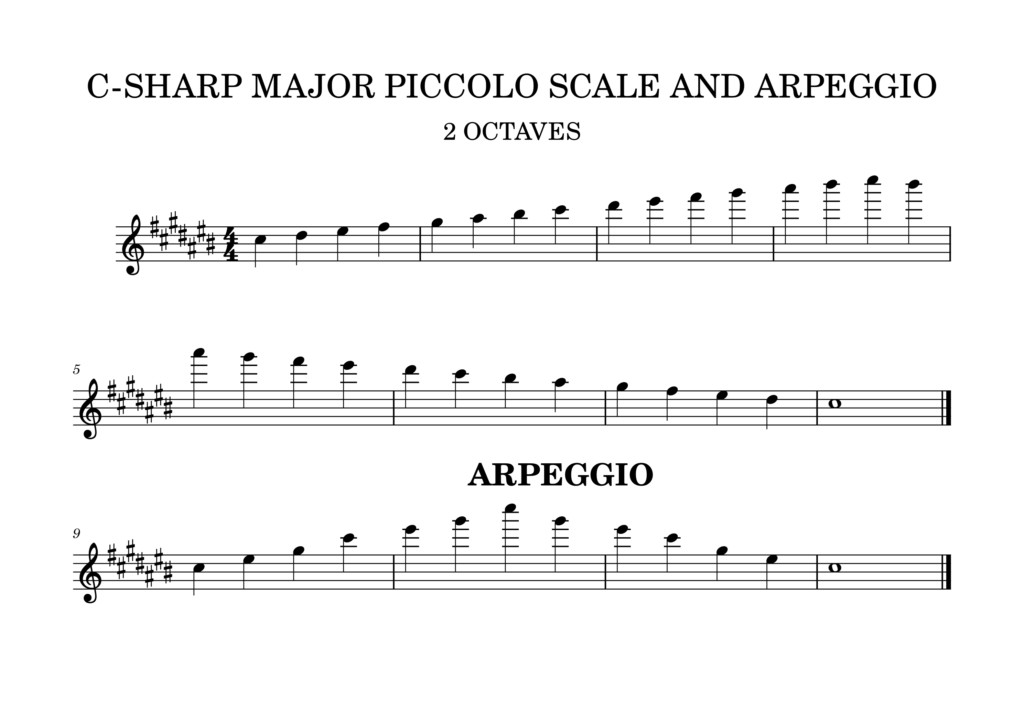
How to play the C-sharp major scale on the piccolo, its notes, and finger placement chat
You can only play a C-sharp major scale of two octaves on the piccolo, being between the ranges of C♯4 – C♯6. You need to use a finger placement chart or a particular pattern to play the C-sharp major scale on the piccolo. Below is a guide and finger chart of how to play the C-sharp major scale on the piccolo;
First octave C-sharp major scale notes (C♯4 – C♯5) finger placement chart for piccolo
To play the first octave (C♯4 – C♯5) C-sharp major scale on the piccolo, you have to sharpen the F note, C note, G note, D note, A note, E note, and B note. Your finger placement needs to be accurate to produce a perfect scale. Below is a chart for the first octave of the C-sharp major scale on the piccolo;
Second octave C-sharp major scale notes (C♯5 – C♯6) finger placement chart for piccolo
To play the second octave (C♯5 – C♯6) C-sharp major scale on the piccolo, you have to sharpen the F note, C note, G note, D note, A note, E note, and B note. Your finger placement needs to be accurate to produce a perfect scale. Learning the scale might be hard for beginners. You will also have to tighten your lips to produce higher-pitched notes. Below is a chart for the second octave C-sharp major scale on the piccolo;
Concert C-sharp major scale
While playing the C-sharp major scale, or playing a composition written in C-sharp major for the piccolo in a concert, you will have to sharpen the F note, C note, G note, D note, A note, E note and B note unless where indicated to be naturalized. This means that all notes are sharpened while playing this scale on the concert piccolo, Indian or Bansuri piccolo, Native American piccolo, pan piccolo, Arabian piccolo, and any other piccolo.
If you play an alto piccolo or any other transposable piccolo, you can play the C-sharp major scale without any transposition. But while running the C-sharp major scale with another instrument that is not transposable, you will then have to transpose to the right key in other to sound the same with them in pitch.
C-sharp major scale piccolo notes and arpeggio
The C-sharp major scale can be played up to two octaves on a C piccolo, or the standard concert piccolo. The first note of this scale on the C piccolo is the C-sharp note on the first ledger line below the treble clef which in the range is the C♯4.
The notes or alphabets that you will play to get this scale correctly include; C♯, D♯, E♯, F♯, G♯, A♯, B♯, and C♯. The two-octave arpeggio of this scale has its notes as C♯, E♯, G♯, C♯, E♯, G♯, C♯, G♯, E♯, C♯, G♯, E♯, C♯.

Notable piccolo compositions in C-sharp major
- Study No. 15 in C-sharp major from Daily Exercises for piccolo, Op. 71 by A. Terschak
- Study No. 15 in C-sharp major from 24 Technical Studies, Op. 11 by E. Prill
- Study No. 15 in C-sharp major from 24 Studies for the Promotion of Technique, Op. 12 by E. Prill
- Study No. 15 in C-sharp major from 30 Studies in All Keys, Op. 6 by E. Prill
- Study No. 3 in C-sharp major from Studies for piccolo by N. Dôthel