Skip to content
 Playing the piccolo can be a challenge, even for experienced musicians. C flat note on the piccolo is one of the most elusive notes on the piccolo. This note can be difficult to produce and sustain, and many flutists struggle with it. In this article, we’ll explore the techniques and tips that can help you master this challenging note, and improve your overall piccolo playing.
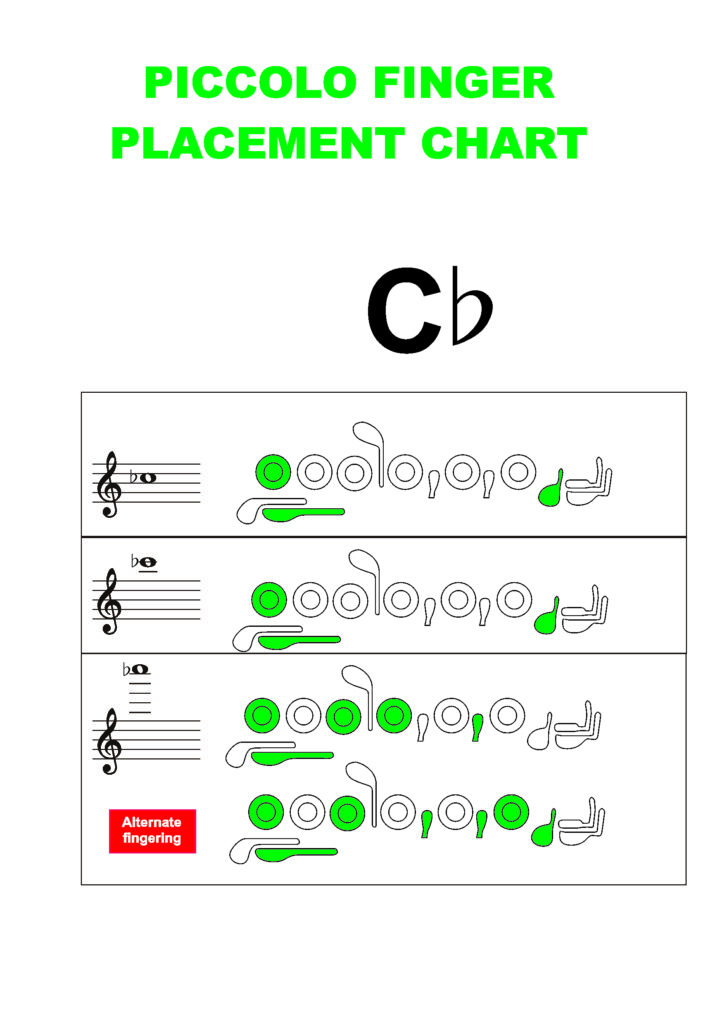
C flat finger placement chart on piccolo: first, second, third, and fourth octave.
What is C flat on the piccolo?
C flat is a note that is not commonly used in music, and it can be confusing for musicians. On the piccolo, C flat is the same note as B natural, but it is written as C flat to fit the key signature of certain pieces of music. This means that the finger placements for C flat are the same as for B natural. However, producing a clear and consistent C flat can be challenging, as the note is often played in the upper register of the piccolo.
How to play low C flat on the piccolo
To play C flat on the piccolo, you’ll need to use the same finger placement as for B natural. Here is the finger placement for C flat on the piccolo:
- Left Hand: First finger and the thumb will cover their assigned keys, but the thumb will be on the B key at the backside of the piccolo.
- Right Hand: The little finger will cover the D sharp key.
It’s important to ensure that your fingers are covering the tone holes completely and that you’re not squeezing the piccolo too tightly. With practice, you’ll be able to produce a clear and consistent C flat.

How to play high C flat on the piccolo
The high C flat on the piccolo is the same as the high B natural, this means that you can use the same basic finger placement for the high B natural to play the high C flat. Here is the finger placement for high C flat on piccolo:
- Left Hand: First finger, ring finger, and thumb will cover their assigned keys, but the thumb will be on the B key at the backside of the piccolo.
- Right Hand: The little finger will cover the D sharp key while the index finger will press the D trill key, the middle finger will press the D sharp trill lever, ring finger will be on its supposed key.

C flat major scale on piccolo: Exercises for Mastering C Flat on piccolo

Practicing the scale of any key will help you master that key. C flat major is seven flats. Practice is essential for mastering any challenging note on the piccolo, and C flat is no exception. Here are some exercises that can help you improve your C flat playing:
- Play long tones on C flat, gradually increasing the length and volume of each note.
- Practice scales and arpeggios that include C flat, focusing on producing a clear and consistent tone.
- Play simple melodies that include C flat, such as “Mary Had a Little Lamb” or “Twinkle Twinkle Little Star,” to build your confidence and familiarity with the note.
- Go ahead and practice studies written for piccolo in C flat key signature such as Study No. 29 in C-flat major from 30 Etüden in Allen Tonarten, Op. 6 composed by E. Prill.
Tips for Producing C Flat on piccolo
Producing a clear and consistent C flat can be a challenge, but there are a few tips that can help. Here are some suggestions:
- Use proper posture and breath support to ensure a strong and steady airflow.
- Focus on keeping your fingers relaxed and light, and avoid squeezing the piccolo too tightly.
- Experiment with the position of your lips and the angle of the piccolo to find the most comfortable and effective position for producing C flat.
- Practice playing long tones on C flat to build endurance and control.
Common Mistakes to Avoid When Playing C Flat on piccolo
When playing C flat on piccolo, there are some common mistakes to watch out for. Here are a few things to avoid:
- Squeezing the piccolo too tightly, which can cause a thin or weak sound.
- Failing to cover the tone holes completely, which can result in a fuzzy or unclear tone.
- Dont play with poor posture or breath support, which can cause a lack of control and stability in the sound.
By avoiding these common mistakes, you’ll be able to produce a clear and consistent C flat on the piccolo.
FAQs about C Flat on piccolo
Q: Is C flat a common note on the piccolo? A: No, C flat is not a common note on the piccolo. It is often used in music with a specific key signature, but it is not a note that is commonly used in most music.
Q: Why is C flat used instead of B natural in some music? A: C flat is used in music to fit the key signature of certain pieces. In these cases, it is easier to write the note as C flat rather than B natural to avoid adding additional accidentals to the music.
Q: Why is C flat on piccolo so challenging to play? A: C flat on piccolo can be challenging to play because it is often played in the upper register of the instrument, where control and stability can be more difficult to achieve. Additionally, the note requires precise finger placements and control of the airstream to produce a clear and consistent sound.
Playing C flat on piccolo can be a challenge, but with practice and the right techniques, it is a note that can be mastered. By using the correct finger placements, focusing on breath support and posture, and practicing consistently, you can improve your ability to play this elusive note. With persistence and dedication, you’ll be able to play C flat with confidence and control, enhancing your overall piccolo playing ability.